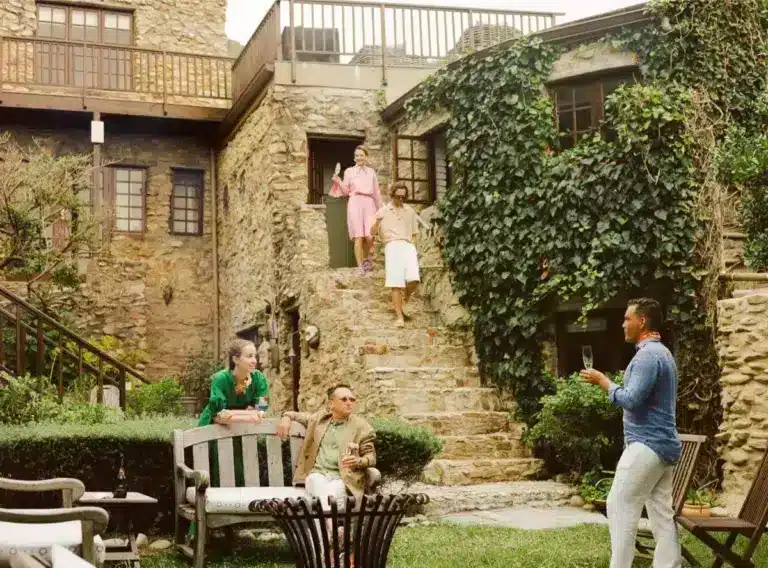
Tim’s Take: The communal dinner table is the decision that stays with me, because Sabina and Toby were told it would cost them honeymooners and they kept it anyway. Every hotel I score comes back to one question, whether you left feeling better than when you arrived, and their answer starts with leaving TVs out of the bedrooms and asking guests to switch off. After 15 years on the road, the evenings I remember most were shared with strangers at a long table. Domu is built for exactly that kind of evening, and that’s why it belongs in this series.
Where the Idea for Domu Retreat Began
Over the years, as we worked in and sampled hospitality at different levels and in different countries, we always paid attention to and discussed everything that affected our experience.
All the small details, little gestures, and seemingly unimportant moments would make a huge difference either way. Was staff aware of their impression? Were these deeds intended? If so, what was behind their design?
Luxury hospitality will have a different definition for different people, depending on their day-to-day lives, their upbringing, and the culture they were raised in.
We started to apply that analytical lens to any hospitality experience, regardless of the price tag, deepening our own understanding of what luxury means to us.
In a way, Domu Retreat was born out of the exploration for those core elements of “luxury”, present in all offerings across budgets, guest types and cultures.
How do our decisions regarding any design choices, processes and behaviours make people feel? What experience do they contribute towards? Is the intention to simply impress or to go beyond the superficial? Where is the truth in the service performed?


Designing Wellness Around Our Own Values
We didn’t want to create what we perceive as wellness, around amenities and services that are often perceived as “musts” or are expected in a luxury setting. Instead, we built around our values and beliefs, hoping that these decisions will resonate with guests.
Having television sets and mini fridges in the bedrooms, no matter how state of the art they are, has an impact on our nervous system and how we relate to our surroundings. We will not have those.
A helicopter arrival has an impact not only on the guests already present on the property but also on surrounding nature and neighbours. We will do without.
Single-use slippers in high-end hospitality generate millions of tonnes of waste which can take hundreds of years to degrade and turn into microplastics. This will not be our contribution.
What Wellness Means at Domu


Ultimately, wellness will look different to different people – for some, it will be optimising their health protocols as much as possible, sticking to certain routines, etc while for others, it will be the opposite.
For us, there cannot be “wellness” without care. One needs to feel genuinely cared for and safe to experience a sense of wellbeing, without judgement.
There cannot be “wellness” without connection to nature – as uninterrupted and unfussed as possible. There cannot be “wellness” without being present, in a quiet contemplation of nature and our place in the universe.
And finally, there cannot be “wellness” without a human connection – beyond geography, politics and money. Simple in its oldest form, analogue and natural, based in curiosity and openness about others’ experience of life, where similarities unite.
A Day at Domu Retreat


The day at Domu is designed around those values of wellness. You are encouraged to switch off your devices and allow yourself to slow down. Tune your senses into what lies outside – sprawling views of Tasman Bay and Abel Tasman mountains, the ever-present symphony of New Zealand birdsong, the scent of Manuka trees and sea breeze.
Wood-fired sauna with views to the mountains, hot tub and swimming pool provide a backdrop for finding some quiet and peace.
You can come to a morning yoga practice, designed to support that connection to yourself and nature, not performative or challenging in obvious ways. On rainy days, after a nurturing massage, you can reach into our library of books carefully chosen for their ideas and content, which once again facilitate our connection to nature and others.
At the end of your day, you meet and connect with other travellers, as we bring all the guests together for a nourishing dinner and discourse.
Nobody eats separately, nobody gets left behind in a conversation, nobody is uncared for, no matter who they are. In today’s digital age, our fundamental need for human connection is often overlooked and therefore rarely considered as essential within the wellness space.
The Case for One Communal Table


The communal dining at one table is an aspect of our offering that was initially met with a lot of reservations. People often cannot associate an experience with “luxury” unless it has the words exclusive or private attached to it – exclusive table, private dining, etc.
We were told that it would put off honeymooners and high-end travellers looking for privacy. And the criticism was not wrong; we are not a destination for everybody. But we do stand by our belief that our sense of wellness is directly linked to the quality of true human interactions we experience.
So the communal four-course dinner, with individual hand-signed menus and wine pairings, where everyone is essentially at the exclusive chef’s table, remains at the heart of Domu.
At Domu, we try to consider what our guests see and hear in our spaces, what they touch and smell, how the energy flows, and how these elements are connected to nature and impact their nervous system and a sense of wellbeing.
We then ensure that we are fully present and caring in all our interactions with the guests, even those invisible to them.


Sabina brings a unique blend of international hospitality expertise, corporate leadership, and wellness experience to her role at Domu Retreat. Born and raised in Kraków, Poland, she trained as a dancer before moving to London at 18, where she earned a Bachelor’s Degree in Dance Studies from Roehampton University. Alongside her studies, she worked in hotels and restaurants, gaining hands-on experience across guest services, dining, bar, and staff training.